
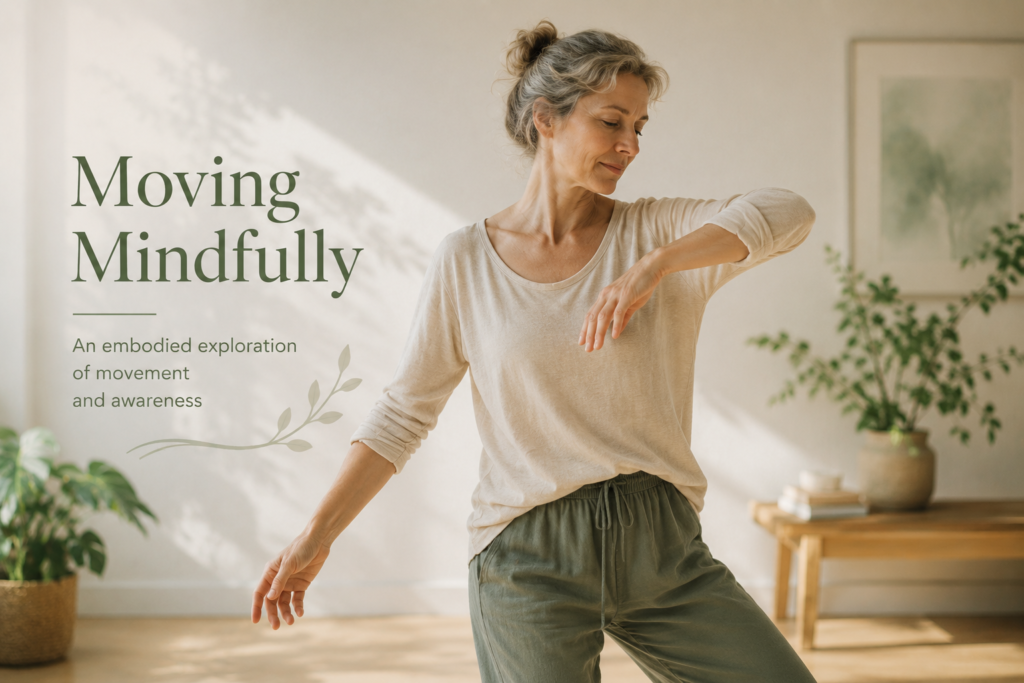
An embodied exploration of movement and awareness.
Mindfulness is often associated with sitting quietly and paying attention to the breath. But awareness can also be cultivated through movement.
Moving mindfully means bringing your attention to your body as you move — noticing sensations, impulses, rhythm, space and the experience of being in your body.
There is no particular way you need to move and no right or wrong experience. You might make very small movements, move more freely, or find yourself wanting to pause and be still. The invitation is simply to notice what happens when you bring your attention to movement.
Begin by arriving
Take a moment to notice how you are right now.
You might be sitting or standing. Notice the support beneath you. Notice where your body makes contact with the chair or the floor.
Without needing to change anything, notice your breathing.
How does your body feel today?
You don’t need to find an answer. Simply notice.
Start to move
Begin with a small movement.
Perhaps gently move your hands, shoulders, head or feet. You might stretch, sway or shift your weight.
Let the movement be comfortable and easy.
As you move, bring your attention to the experience of moving rather than how the movement looks.
You might notice:
- sensations in different parts of your body
- changes in your breathing
- where you feel ease or tension
- warmth, coolness, lightness or heaviness
- the rhythm or pace of your movement
- the feeling of your feet connecting with the floor
- how much space your body occupies.
There is no need to change anything you notice.
Follow your movement
If it feels comfortable, allow your movement to develop.
You could explore moving:
Slowly or quickly.
What happens when you change the pace?
With more or less effort.
What is it like to make a movement smaller or larger?
In different directions.
What happens when you reach, turn, circle or change your level?
With different parts of your body.
Perhaps your hands lead, then your shoulders, feet or whole body.
You don’t need to copy anyone else.
You might discover a movement that feels particularly comfortable, unfamiliar, enjoyable or interesting. You can stay with it for a while if you wish.
Or you might find yourself wanting to stop.
Stillness is part of movement too.
Notice your choices
As you continue, see if you can notice your own choices.
What happens when you allow yourself to decide:
I want to move this way.
I want to move more slowly.
I want to stop.
I want to try something different.
There is no need to make the movement look a particular way or achieve anything.
You are simply exploring your own experience.
Coming back
When you are ready, gradually allow the movement to become smaller or come to an end.
Notice your body again.
Feel the support of the floor or chair.
Notice your breathing.
Has anything changed?
Perhaps you feel different. Perhaps you don’t.
You don’t need to make a judgement about your experience.
Just notice.
A few things to reflect on
If you would like to spend a little longer with the experience, you might ask yourself:
- What did I notice about my body as I moved?
- Was there a movement that felt particularly comfortable or interesting?
- Did anything surprise me?
- What was it like to have choices about how I moved?
- How did stillness feel?
- Is there anything I would like to take from this experience into the rest of my day?
There is no need to write anything down unless you want to. The reflection can simply be something you notice and carry with you.
A gentle reminder
Move in a way that feels appropriate for you today. You can make movements smaller, change them, pause or stop at any time.
This isn’t about doing movement correctly. It is an opportunity to become curious about your own embodied experience.