
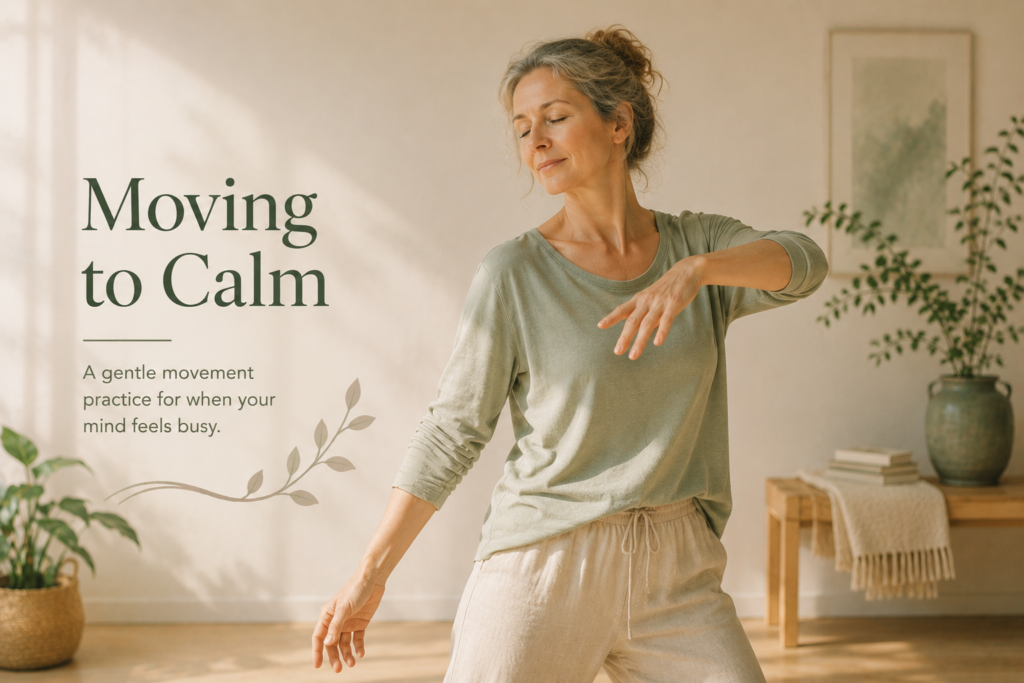
A gentle movement practice for when your mind feels busy.
When your mind is busy, sitting still and trying to quiet your thoughts isn’t always easy. Sometimes, movement can offer another way of finding a little more space and ease.
This practice invites you to explore simple, rhythmic movements and notice what happens. There is no need to make yourself feel calm. Instead, you are giving yourself an opportunity to move, breathe and become aware of your experience.
You can do this standing or sitting, and you can make the movements as small as you like.
Begin where you are
Take a moment to notice how you are right now.
Notice the support beneath you — the floor, a chair or whatever is holding your weight.
You might notice your breathing without trying to change it.
Perhaps your mind feels busy, your body feels restless, or you feel tired or tense.
There is nothing you need to fix.
Just notice what is here.
Find a gentle rhythm
Begin with a small, repetitive movement.
You could slowly sway from side to side, gently rock your weight forwards and backwards, or move your hands in a simple rhythm.
If you are sitting, you might gently move your hands, feet or shoulders.
Let the movement be easy.
There is no need to make it large or precise.
As you move, see if you can become aware of the rhythm.
Left and right.
Forward and back.
Move and pause.
Perhaps allow your breathing to find its own rhythm alongside the movement.
Let the movement support your attention
When your mind wanders, you don’t need to bring it back by force.
Instead, return your attention to something you can feel:
the movement of your body,
your feet meeting the floor,
the shifting of your weight,
the movement of your breath.
You might find it helpful to repeat the same movement for a little while.
Notice whether the repetition gives your attention somewhere to rest.
Your thoughts may continue.
That’s okay.
The aim isn’t to stop thinking.
It is simply to give yourself another way of experiencing the present moment.
Explore the pace
If it feels comfortable, experiment with changing the pace.
Try moving a little more slowly.
Notice what happens.
Then perhaps allow the movement to become slightly quicker or more energetic.
Notice the difference.
You might discover that one pace feels more settling than another.
Or you might prefer to move between different rhythms.
There is no right answer.
You are learning about your own experience.
Add your whole body
If you would like to, allow the movement to travel through more of your body.
Perhaps let your arms join the movement.
You might reach gently, circle your arms, sway through your spine or allow your shoulders to move.
You could take a few steps around the room, allowing your walking to become rhythmic and purposeful.
Notice the feeling of your feet making contact with the ground.
Notice the movement of your body through space.
Let the movement be your own.
Coming towards stillness
Gradually allow the movement to become smaller.
Perhaps slow your rhythm until you come to stillness.
Notice what it is like to stop.
Feel the support beneath you.
Notice your breathing.
Notice your body.
And notice your mind.
Has anything changed?
Perhaps you feel more settled.
Perhaps you feel more awake.
Perhaps you are still restless or your thoughts are still busy.
Whatever you notice is okay.
You don’t have to achieve calm for the practice to have been worthwhile.
Sometimes simply taking a few moments to move differently from how we have been moving can create a little more space.
You can return to this practice in different ways
You don’t have to set aside twenty minutes to move.
You might find a few moments of rhythmic movement useful:
- before starting work
- after sitting for a long time
- when your thoughts feel particularly busy
- between activities
- when you feel restless
- before settling down for the evening.
You could even choose a simple movement that you enjoy and repeat it for the length of one piece of music.
A few things to notice
Afterwards, you might ask yourself:
- What did I notice when I began?
- Did the rhythm give my attention somewhere to rest?
- How did different speeds of movement feel?
- Did anything change in my body, thoughts or feelings?
- What kind of movement feels supportive when my mind is busy?
You don’t need to analyse your experience. Curiosity is enough.
A gentle reminder
Move in a way that feels comfortable and appropriate for you today. You can make the movements smaller, change them, pause or stop whenever you need to.
If movement doesn’t feel right, you can simply sit or stand and notice your surroundings instead.
There is no need to make yourself calm.
Sometimes, by moving, noticing and giving ourselves a little space, we discover that calm can emerge in its own time. how the body talks to the mind -with the language of sensation.